
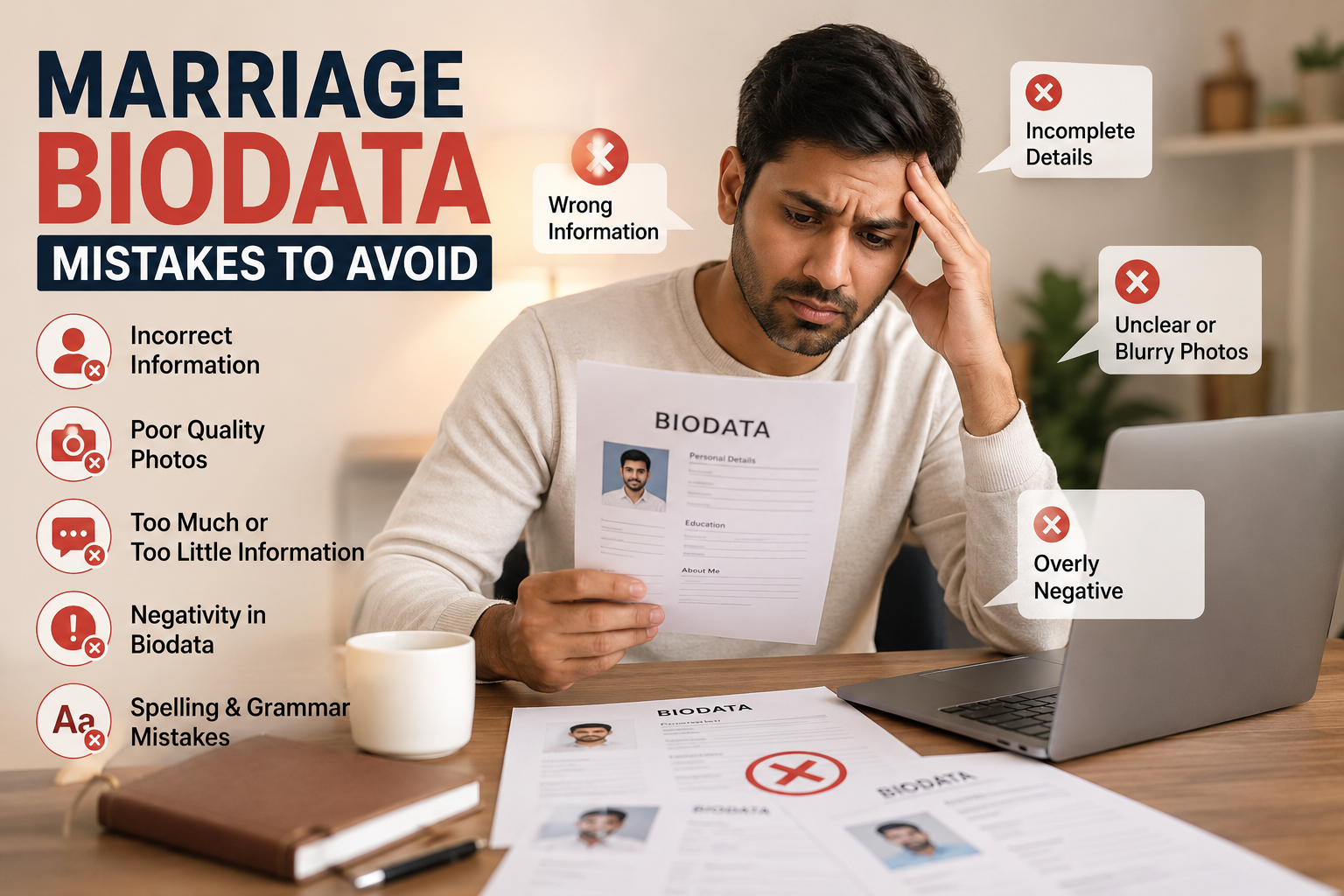
Marriage Biodata Mistakes to Avoid: 15 Common Errors That Can Hurt Your First Impression
Marriage Biodata Mistakes to Avoid
Preparing a marriage biodata may look simple, but small mistakes can affect the way a prospective match or family understands your profile.
A good biodata doesn't need fancy designs or dozens of details.
It needs accurate information, a clear presentation and a genuine introduction.
Here are 15 common mistakes to avoid.
1. Using an Outdated Photograph
Your photograph should represent how you currently look.
Avoid using a photo that is several years old or heavily edited.
Choose a recent, clear and natural photograph.
2. Using Group Photos
A matrimonial biodata should make it immediately clear who the profile belongs to.
Avoid using a group photograph as the primary image.
3. Writing a Very Generic Introduction
Statements such as:
“Simple, caring and family-oriented.”
are extremely common.
Instead, mention something specific about your personality, interests, career or lifestyle.
4. Providing Incomplete Information
A biodata containing only:
Name + Age + Education + Photo
may leave many basic questions unanswered.
Where appropriate, add:
- Profession
- City
- Family background
- Interests
- Lifestyle
- Partner expectations
5. Exaggerating Your Career or Education
Never add qualifications or professional achievements that aren't accurate.
Trust is important in matrimonial relationships.
6. Turning the Biodata Into a Resume
A marriage biodata is not a job CV.
Your professional achievements are useful, but don't fill the entire document with career details.
Include enough professional information to help someone understand your background.
7. Listing Too Many Partner Requirements
A very long list can make your profile appear unrealistic.
Instead of listing 20–30 conditions, identify the qualities that are genuinely important.
8. Using Negative Language
Avoid phrases such as:
- “Don't contact if...”
- “No timepass.”
- “Must have...”
- “I don't want...”
Communicate preferences respectfully.
9. Sharing Too Much Personal Information
Don't unnecessarily include:
- Exact home address
- Bank details
- Financial account information
- Passwords
- OTPs
- Confidential workplace information
- Other sensitive information
Your matrimonial biodata should provide useful information without compromising privacy.
10. Making False Salary Claims
Financial information should be accurate.
If income is included, provide a reasonable and honest description rather than exaggerating it to attract attention.
11. Ignoring Spelling & Grammar
A biodata with multiple spelling mistakes can look rushed.
Before sending it, check:
- Name spelling
- Education
- Job title
- City
- Dates
- Family details
A quick review can make a big difference.
12. Making the Design Too Complicated
A marriage biodata doesn't need excessive colours, decorative elements or difficult-to-read fonts.
Keep the design:
Simple + Clean + Professional
The information should remain the focus.
13. Hiding Important Expectations
While you shouldn't list dozens of conditions, important expectations should not be hidden.
For example:
- Career plans
- Relocation
- Lifestyle
- Family responsibilities
- Future goals
These can be discussed at the appropriate stage.
14. Not Updating the Biodata
If you change your:
- Job
- City
- Education
- Lifestyle
- Partner preferences
update your biodata.
An outdated profile can create unnecessary confusion.
15. Sending the Same Generic Biodata Everywhere
A single standard biodata can work as a starting point, but your introduction should still accurately represent you.
If your profile is being shared with different families, make sure the information remains relevant and current.
Quick Marriage Biodata Checklist
Before sending your biodata, ask:
☑ Is my photograph recent?
☑ Is all information accurate?
☑ Is my education clearly mentioned?
☑ Is my profession clearly explained?
☑ Is my family information appropriate?
☑ Have I mentioned genuine interests?
☑ Are my partner expectations realistic?
☑ Have I removed unnecessary personal information?
☑ Have I checked spelling and grammar?
☑ Is the design easy to read?
If the answer is yes to all of these, your biodata is ready for the next step.
Biodata vs Matrimonial Profile
A biodata is usually a document that can be shared with families.
A matrimonial profile is more interactive and can be updated as your circumstances change.
For online matchmaking, maintaining a complete and updated matrimonial profile is equally important.
With LagnaVaarta Marathi Matrimony, your profile can act as your online introduction to potential matches.
Final Thoughts
The purpose of a marriage biodata is not to impress everyone.
It is to provide honest and useful information to the right potential match.
Avoid exaggerated claims, excessive requirements, outdated photographs and unnecessary personal information.
Keep your biodata simple, genuine and updated—and let your personality speak for itself.
Your biodata opens the conversation. Compatibility builds the relationship.
FAQs
What is the biggest marriage biodata mistake?
One of the biggest mistakes is providing incomplete or inaccurate information. A biodata should give a genuine and clear introduction.
Should a marriage biodata have a photo?
A recent and clear photograph is generally useful, but choose one that is appropriate for matrimonial purposes.
How long should a marriage biodata be?
There is no fixed length. It should be long enough to provide important information but concise enough to remain easy to read.
Should I include salary in my biodata?
This is a personal choice. If you include professional or income information, make sure it is accurate and avoid sharing sensitive financial details.
Can I create a marriage biodata online?
Yes. You can create a digital matrimonial profile and use a separate PDF or document biodata when families request one.
